
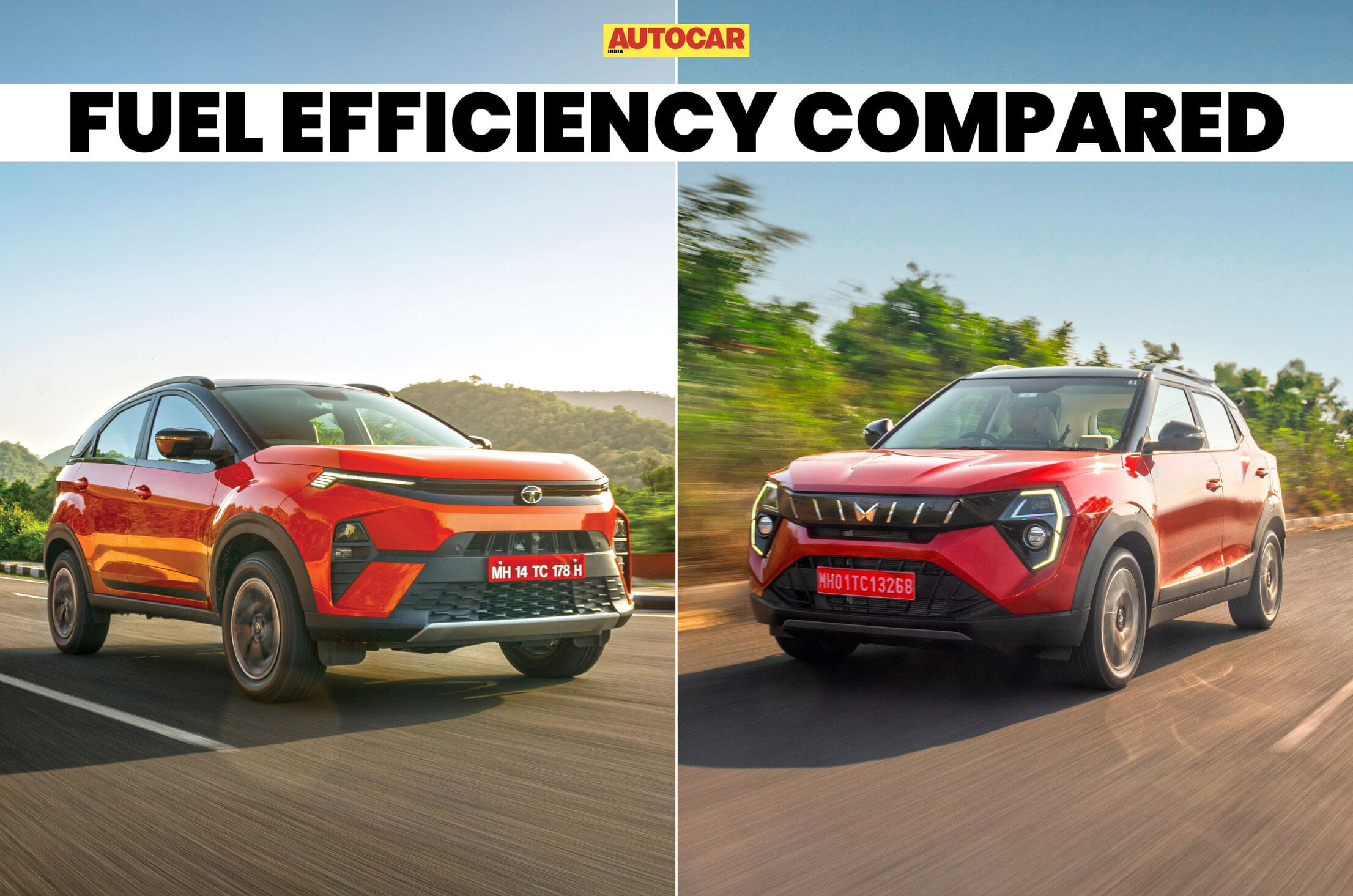
The Tata Nexon and Mahindra XUV 3XO offer buyers two types of turbo-petrol engines. All turbo-petrol versions of the Nexon use multi-point fuel injection (MPFI), with lower trims being mated to an AMT (automated manual transmission) gearbox, while higher trims use a dual-clutch automatic (DCT) gearbox. Meanwhile, all turbo-petrol versions of the XUV 3XO feature a 6-speed torque converter automatic transmission (AT), with gasoline direct injection (GDI) only reserved for the top-spec version. So, if you want the convenience of a proper automatic gearbox plus the performance associated with a turbo-petrol engine without sacrificing fuel economy, which of these two cars should you consider?
Explore full specs, features and a price breakdown in our Nexon vs XUV 3XO comparison.
Tata Nexon vs Mahindra XUV 3XO turbo-petrol automatic: Specifications
While torque spread is comparable in both, the XUV 3XO has a distinct power advantage
Tata Nexon vs Mahindra XUV 3XO automatic: Specifications | ||
| Tata Nexon | Mahindra XUV 3XO |
Engine | 3 cyl, petrol | 3 cyl, petrol |
Displacement (cc) | 1199 | 1197 |
Power (hp) | 120 (5,500rpm) | 131 (5,000rpm) |
Torque (Nm) | 170 (1,750-4,000rpm) | 230 (1,500-3750rpm) |
Gearbox | 7-speed DCT | 6-speed AT |
Fuel tank (litres) | 44 | 42 |
At first glance, the turbo-petrol engines powering the Nexon and XUV 3XO look identical, as both are three-cylinder units with a displacement of 1.2 litres. Since the GDI system typically allows a more complete combustion of fuel, it benefits include more power and better fuel economy over a similar-sized MPFI system.
The XUV 3XO’s direct injection turbo-petrol setup offers 11hp and 60Nm more than its equivalent Nexon version. However, peak torque of these engines is spread out over an identical range of 2,250rpm. The Tata SUV features a 7-speed dual-clutch automatic transmission (DCT), while the top-spec XUV 3XO petrol comes mated to a 6-speed torque converter automatic transmission (AT). Also, the fuel tank of the Tata SUV has a slightly higher capacity, by two litres.
Tata Nexon vs Mahindra XUV 3XO turbo-petrol automatic: Real-world fuel efficiency
Despite having the punchier engine, the XUV 3XO’s fuel economy is better than the Nexon
Tata Nexon vs Mahindra XUV 3XO automatic: Real-world mileage | ||
| Tata Nexon | Mahindra XUV 3XO |
Tested city mileage (kpl) | 7.70 | 9.89 |
Tested highway mileage (kpl) | 13.90 | 13.01 |
Tested average mileage (kpl) | 10.80 | 11.45 |
The Tata Nexon returned an average that was 0.65kpl poorer than the Mahindra XUV 3XO. Its low mileage of 7.70kpl in city conditions meant that, even with a higher fuel economy of 13.90kpl on the highway, the Nexon’s overall efficiency still lagged behind the XUV 3XO. The efficiency gains of the Nexon on the highway was helped by the extra ratio in its DCT. Compared to the XUV 3XO’s torque convert AT with six ratios, the Nexon’s 7-speed gearbox allows its engine to spin at a more leisurely speed as you pick up pace.
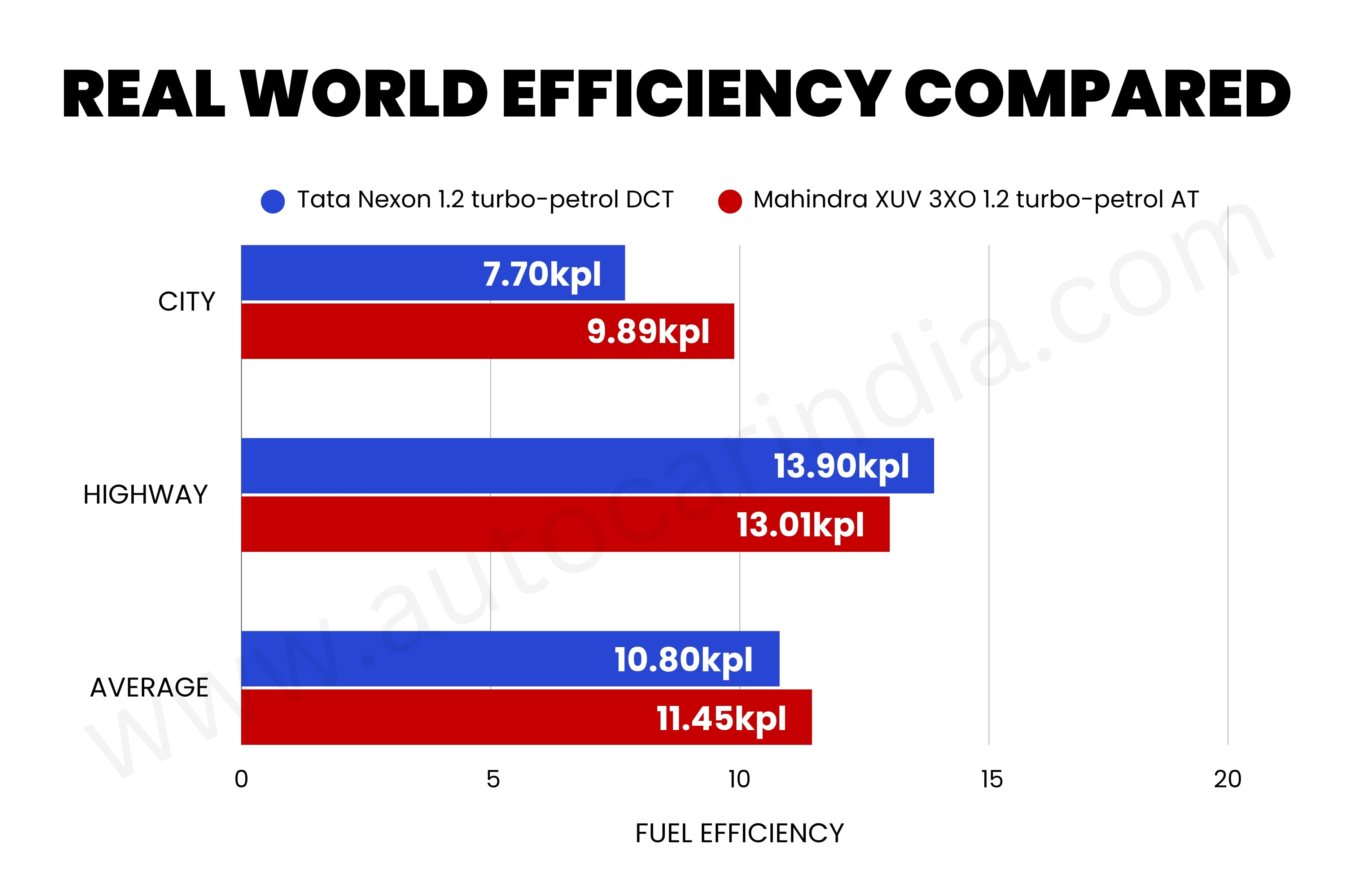
In the city, the XUV 3XO had a clear lead over the Nexon, achieving a real-world fuel economy that was higher by 2.19kpl. The Mahindra XUV 3XO’s direct fuel-injection technology allows petrol to be introduced into the engine in a highly measured and precise manner. This reduces fuel consumption and improves combustion when compared to a similarly sized but MPFI-equipped turbo-petrol engine, like in the Nexon.
Tata Nexon vs Mahindra XUV 3XO turbo-petrol automatic: Prices
Tata Nexon vs Mahindra XUV 3XO turbo-petrol automatic prices | ||
| Tata Nexon | Mahindra XUV 3XO |
Price range (in Rs, lakh) | 11.35-13.70 | 13.28-15.04 |
The turbo-petrol-automatic variants of both the Tata Nexon and Mahindra XUV 3XO are available in three trim levels. For cost-conscious buyers, the most affordable Nexon with this powertrain setup comes in Rs 1.93 lakh cheaper than a comparable XUV 3XO. This price delta continues to the mid-spec trim as well, where the Mahindra is pricier by Rs 79,000. At the top-end, the XUV 3XO’s turbo-petrol automatic variant costs Rs 1.34 lakh more than the equivalent Nexon. One of the reasons for the XUV 3XO's higher price is is its direct-injection fuel system, which costs more than a comparable MPFI unit.
Autocar India’s fuel efficiency testing
Before our real-world fuel efficiency tests, we fill our test cars’ tanks to the brim and maintain tyre pressures based on the manufacturer’s recommendations. These cars are driven in fixed city and highway loops in and around Navi Mumbai, and we maintain certain average speeds. Throughout the tests, there is only one person in each car, running the air conditioner and other electricals, such as the audio system, indicators and wipers, when required, just like a regular user would. Periodic driver swaps further neutralise variations in driver patterns. At the end of each cycle, we calculate efficiency by filling the tanks to full again.
Prices are ex-showroom, India.
Also read
Tata Harrier vs MG Hector petrol automatic: Real world mileage compared
Tata Nexon vs Mahindra XUV 3XO: Real world diesel efficiency compared


