
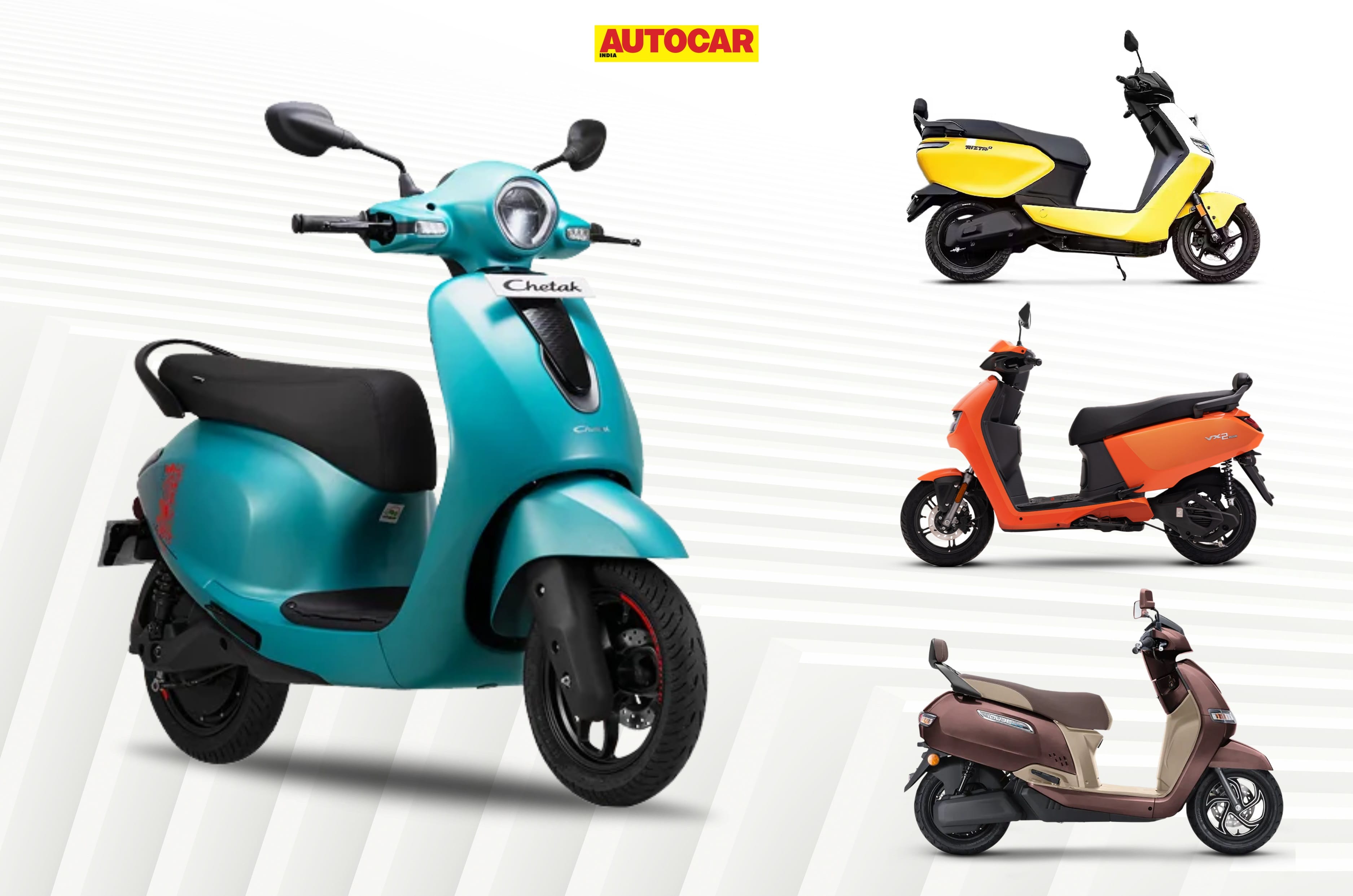
Bajaj has added a new entry point to its electric scooter portfolio with the launch of the Chetak C2501, which is now the smallest model in the Chetak range. It is a ground-up model that sits apart from the 3001 and 35 Series, with no shared platform, components or hardware. Although it carries forward the familiar Chetak design identity, the C2501 is noticeably more compact and pared-back in its execution. Here’s a look at how it compares, on paper, with rival electric scooters from other Indian manufacturers.
Bajaj Chetak C2501 vs rivals: Range comparison
The Chetak gets a slightly larger battery pack than the VX2 and iQube
The TVS iQube and the Vida VX2 Go are equipped with the smallest battery packs in this comparison, which is why they also have the lowest claimed IDC range.
The new Bajaj Chetak sits a step above them, with a slightly larger battery. As a result, its claimed range is better than the iQube and VX2 Go, but still lower than the Rizta S. Talking about the Rizta, it sits at the top of this group and that’s expected as it gets a larger battery pack. At the top of this group is the Ather Rizta S. It gets the largest battery here, translating into the highest claimed range. That said, this is actually the smaller of the two battery options available on the Rizta, as it is also offered with a larger 3.7kWh battery pack.
Bajaj Chetak C2501 vs rivals: Charging time comparison
The Rizta takes the longest to charge, in line with its larger battery capacity
In terms of standard charging performance, the Bajaj Chetak C2501, TVS iQube, and Vida VX2 Go form a closely matched group for quicker top-ups, while the Ather Rizta S sits distinctly apart. The Chetak is the fastest to reach 80 percent, taking 2 hours 25 minutes, with the VX2 Go and iQube following closely behind. The Rizta S, with its larger 2.9kWh battery, takes considerably longer for the same 0–80 percent charge.
The gap narrows slightly when it comes to full charging times, but the hierarchy remains largely unchanged. The Chetak leads with a 0–100 percent charging time of 3 hours 45 minutes, narrowly ahead of the VX2 Go, which takes 3 hours 53 minutes. The Rizta S continues to trail by a wide margin for a full charge. TVS, meanwhile, does not disclose a standard 0–100 percent charging figure for the iQube, limiting a direct full-charge comparison.
Bajaj Chetak C2501 vs rivals: Price
The VX2 Go is the most affordable of this lot
The Vida VX2 Go is the lowest-priced scooter in this set, with its Battery-as-a-Service option further reducing the upfront cost. The TVS iQube sits higher on the price ladder despite using a similarly sized battery.
The Bajaj Chetak C2501, the newest entrant here, slots between the VX2 Go and iQube on price while offering a larger battery. At the top end is the Ather Rizta S, which packs the biggest battery in this comparison and delivers the highest claimed range, albeit with correspondingly longer charging times.


