
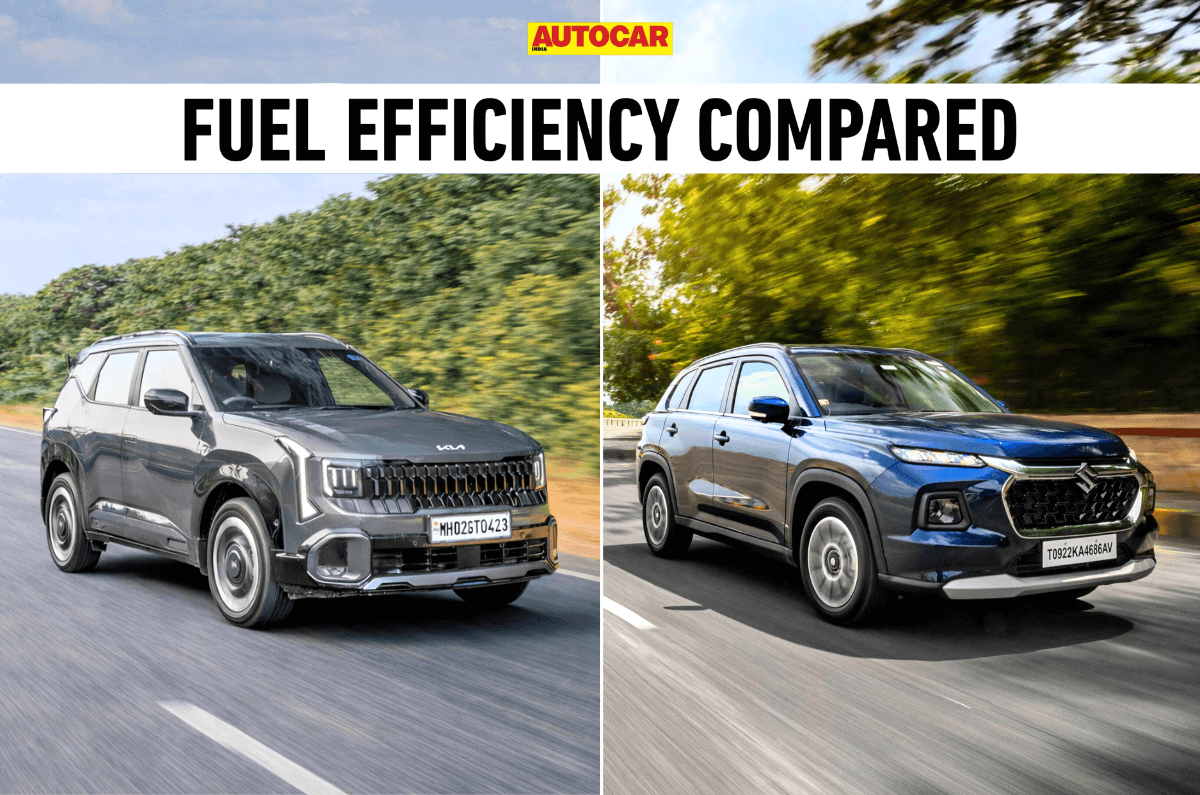
The Kia Seltos and the Maruti Grand Vitara are direct rivals in the midsize SUV segment, and both offer the convenience of an automatic gearbox with their respective naturally aspirated petrol engines. While the Seltos petrol uses a CVT, the Grand Vitara comes equipped with a torque converter. We find out which model is more efficient in the real world.
Kia Seltos CVT vs Maruti Grand Vitara AT: Specifications, price
Seltos pricier by Rs 2.21 lakh at the top-end.
| Midsize SUV | Seltos | Grand Vitara |
| Engine | 1497cc, NA, 4 cyl | 1462cc, NA, 4 cyl |
| Power | 115hp at 6300rpm | 103hp at 6000rpm |
| Torque | 144Nm at 4500rpm | 139Nm at 4300rpm |
| Drive layout | FWD | FWD |
| Gearbox | CVT | 6AT |
| Fuel tank | 47 litres | 45 litres |
| Price (ex-showroom) | Rs 13.39 lakh-19.49 lakh | Rs 13.45 lakh-17.28 lakh |
As the table shows, the Kia SUV clearly leads on engine output here, producing 12hp and 36Nm more than the Maruti Grand Vitara. It's petrol tank is also slightly larger by 2 litres. Their entry prices are nearly identical, meaning buyers opting for the base variant won't see a big cost difference. But the real divergence shows up at the top end, where the Seltos commands a massive premium of Rs 2.21 lakh. For those not in the know, the Maruti SUV can also be optioned with an all-wheel drive layout.
Kia Seltos CVT vs Maruti Grand Vitara AT: Real-world efficiency
Grand Vitara more fuel efficient in both city, highway.
Shift the lens to fuel efficiency and the narrative flips. The Maruti offering's output figures not only suggest a tendency towards economy but our real world tests also prove it is 1.29kpl more frugal in the city and 1.08kpl more efficient on the highway. It should be noted that while both SUVs are equipped with an integrated start-stop generator (ISG) that is meant to aid efficiency in stop/start traffic conditions, the Grand Vitara petrol does not get any drive modes; the Seltos' test was conducted in the efficiency-focused Eco mode.
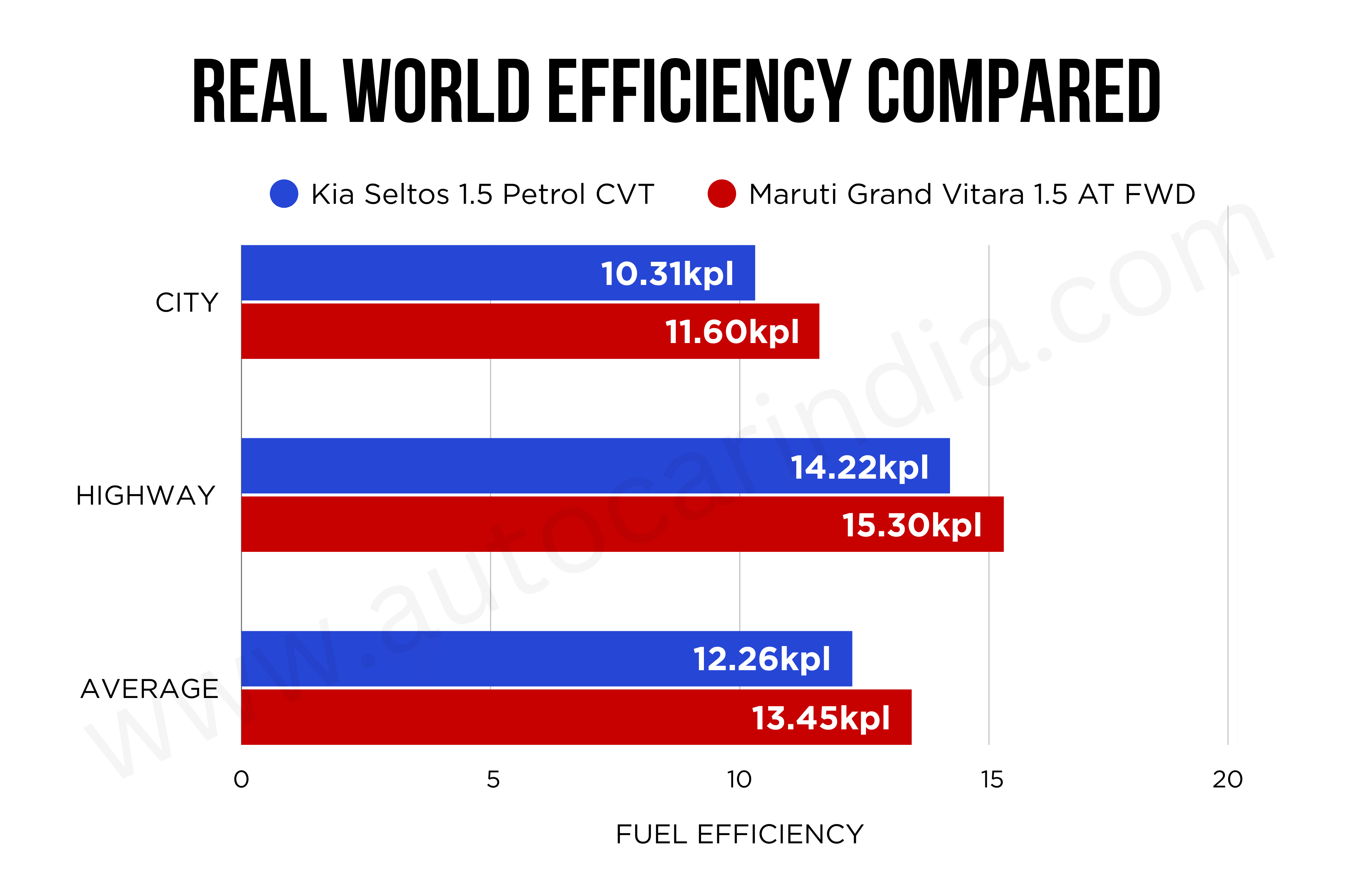
Although Kia has not revealed a kerb weight figure for the second-generation Seltos, it has an overall larger footprint and is likely heavier than its predecessor, which weighed between 1,289-1,361kg. This in turn means that the Seltos continues to be heavier than the Maruti, which has a kerb weight of 1,285kg (FWD AT version). A more powerful engine and a higher weight figure underline why the Seltos is, on average, 1.19kpl less efficient than the Grand Vitara.
Factoring in fuel tank capacity further reinforces the results, as the Seltos can cover 485km in the city and about 668km on the highway on a full tank, whereas the Grand Vitara stretches that to around 522km (+37km) and 688km (+20km), respectively.
Autocar India's fuel efficiency testing standards
Before our real-world fuel-efficiency tests, we fill our test cars' tanks to the brim and maintain tyre pressures based on the manufacturer’s recommendation. These cars are driven in fixed city and highway loops in and around Navi Mumbai, and we maintain certain average speeds. Throughout the tests, there is only one person in each car, running the AC at 22-degrees in full-auto mode and other electricals, such as the audio system, indicators and wipers, when required, just like a regular user would. Periodic driver swaps further neutralise variations in driver patterns. At the end of each cycle, we calculate efficiency by filling the tanks to full again.


