
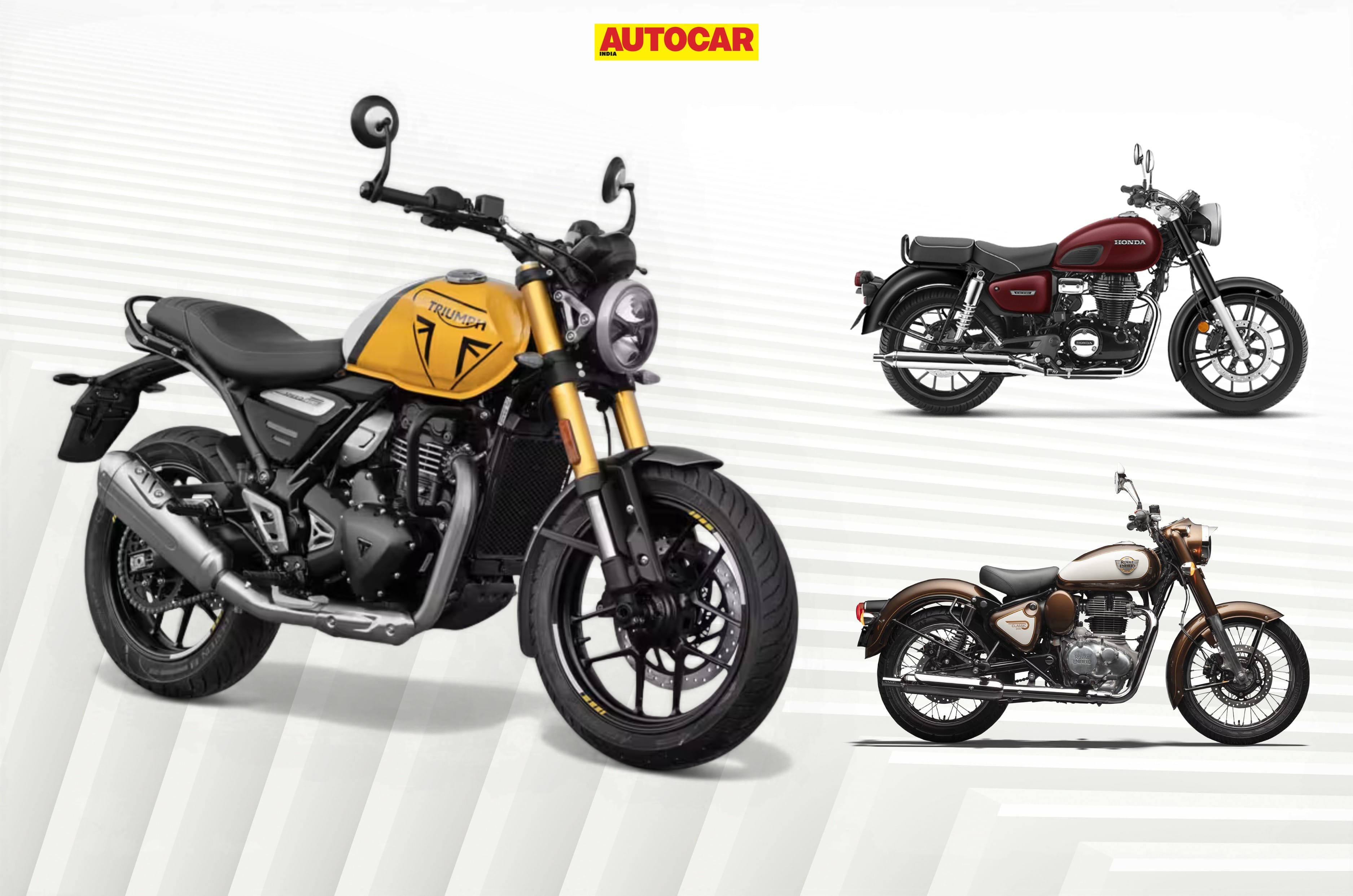
Triumph's decision to downsize its 400cc platform to 349cc has reshaped its competitive landscape. Now, the Speed 400 competes directly with the Honda CB350 and Royal Enfield Classic 350 on displacement terms while benefiting from the lower GST rate. Here’s how the three motorcycles compare on paper.
Triumph Speed 400 vs Honda CB350 vs Royal Enfield Classic 350: engine and output
The Triumph makes notably more power despite the smaller engine
The Triumph Speed 400 holds a clear performance advantage on paper. Despite the downsizing from 400cc, the liquid-cooled DOHC engine produces significantly more power and noticeably more torque than its air-cooled rivals. On the flip side, the Honda CB350 and Classic 350 produce their peak torque much lower in the rev range than the Speed 400, which should translate into better low-speed tractability and easier everyday riding.
The Triumph also gets an additional gear with a 6-speed gearbox, and the Classic 350 is the only one that doesn’t feature a slip-and-assist clutch. That said, its siblings like the Hunter 350 and Goan Classic 350 were recently updated with a slip-and-assist clutch, and we might see the Classic 350 get the feature soon as well.
Triumph Speed 400 vs Honda CB350 vs Royal Enfield Classic 350: weight and dimensions
The Triumph is the lightest of the lot
The Triumph Speed 400 is the lightest of the three at 179kg, giving it a sizeable weight advantage which, when combined with the notably higher peak output figures, results in a significantly better power-to-weight ratio. The Honda CB350 offers the largest fuel tank at 15.2 litres compared to 13 litres on both the Triumph and Royal Enfield, which should give it a tangible range advantage. All three bikes offer similar seat heights in the low-800mm range, making them accessible to most riders.
Triumph Speed 400 vs Honda CB350 vs Royal Enfield Classic 350: suspension, brakes, and tyres
The Triumph gets higher-spec hardware
The Triumph Speed 400 gets the most sophisticated suspension hardware with a USD fork up front and a monoshock at the rear. Both the Honda and Royal Enfield use conventional telescopic forks and get twin shock absorbers with adjustable preload at the rear.
Tyre choices also differ across the three, with the Triumph running a more common 17-inch front and rear setup, which should make for sharper handling. The Honda and Royal Enfield use a larger 19-inch front and 18-inch rear setup.
Triumph Speed 400 vs Honda CB350 vs Royal Enfield Classic 350: price
The Royal Enfield undercuts both rivals
The Royal Enfield Classic 350 is the most affordable option, with prices starting at Rs 1.86 lakh and going up to Rs 2.21 lakh depending on the colour scheme, which also dictates the choice of wheels. The Honda CB350 is priced closely, with prices ranging around the Rs 2.00 lakh mark, while the Triumph Speed 400 commands a fair premium at Rs 2.32 lakh.
That said, on paper, the new Speed 400 justifies its pricing with notably higher performance and more sophisticated hardware. The differences between the three will only be more apparent in the real world, so the Honda and Royal Enfield are not to be discounted and offer characteristics that the Triumph can’t.


