
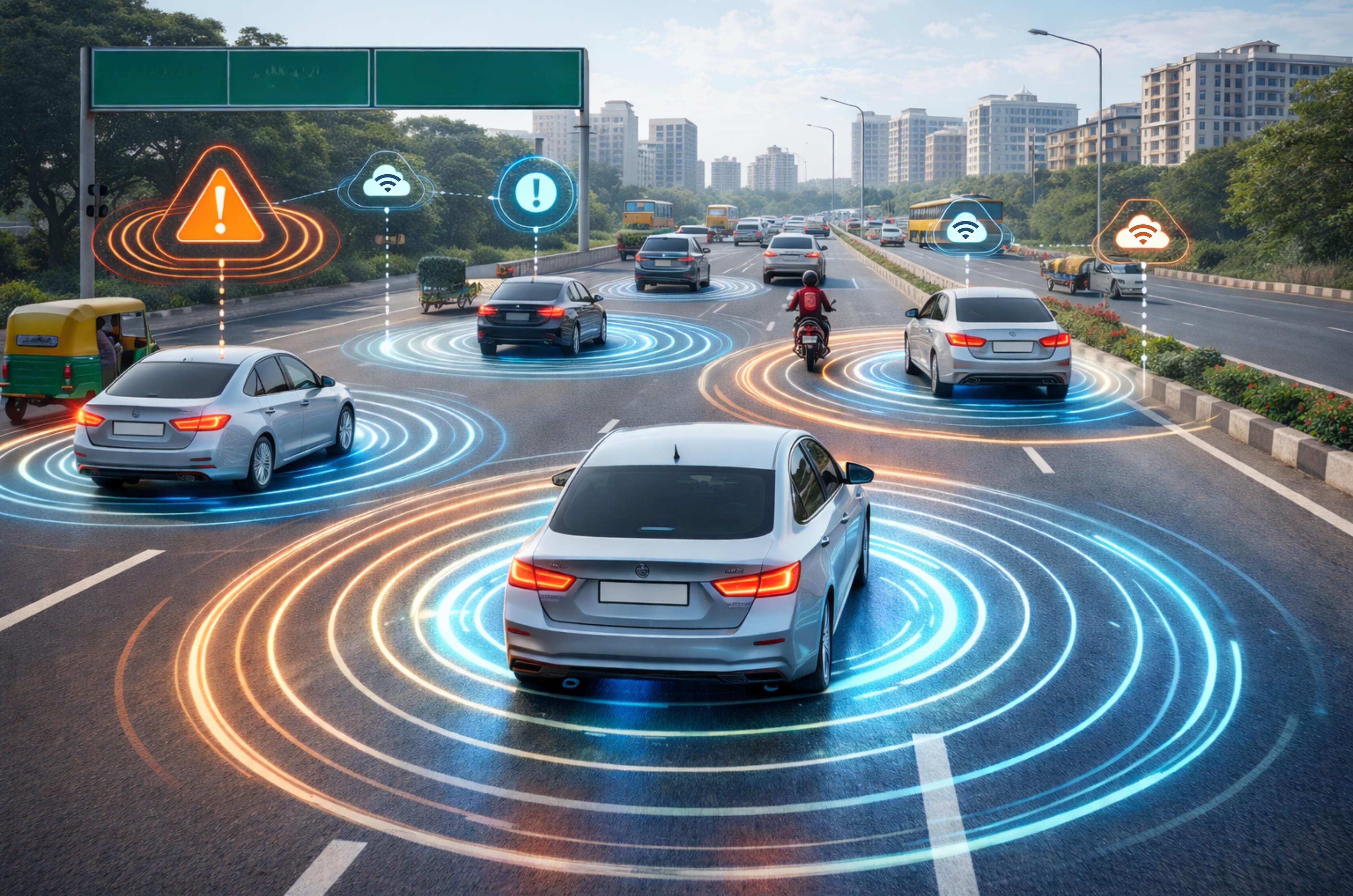
Union minister for road transport and highways Nitin Gadkari has said the government plans to introduce vehicle-to-vehicle (V2V) communication technology and make it mandatory by the end of 2026. The system will allow vehicles to share safety alerts directly with each other to help prevent collisions. The announcement came after a two-day meeting of state transport ministers and senior officials from 28 states and Union Territories, where broader road safety reforms were discussed.
Gadkari said a joint task force has been set up with the Department of Telecommunications (DoT) and that DoT has agreed in principle to allocate 30MHz of spectrum in the 5.875-5.905GHz band for V2V use.
- Vehicles to get on-board units (OBUs) for wireless alerts
- OBU cost estimated at Rs 5,000-7,000 per vehicle
- Initial mandate expected for new vehicles, retrofits later
The proposal is part of a broader push to improve road safety, with the government targeting a 50 percent reduction in road fatalities by 2030. However, with standards still being finalized and added hardware costs likely, the proposal raises questions on how realistic the timeline is.
What V2V will do
Under the plan, vehicles are expected to be mandatorily fitted with an on-board unit (OBU) that sends key information to nearby vehicles, including location, speed, direction and braking. This allows drivers to receive warnings even before a hazard is visible. It can help in situations such as sudden braking at high speeds, a vehicle stopped ahead, low visibility in fog, or traffic approaching from blind spots or at intersections.
Gadkari has described the system as allowing drivers to “talk to each other like pilots”.
Timeline, standards and cost
The rollout has been targeted for completion by the end of 2026, with reports suggesting the overall programme cost could be around Rs 5,000 crore.
The initial mandate is expected to apply to new vehicles first, followed by older vehicles in later phases through retrofitting. On-board units (OBUs) are also planned to be mandatory for buses, trucks and other large vehicles.
Road transport secretary V Umashankar said technical standards are being finalised with vehicle manufacturers, after which a formal notification will be issued. Gadkari added that the ministry is working with carmakers and technology firms on a roadmap to roll out V2V across the country.
Challenges for a nationwide rollout
While the safety benefits sound promising, a nationwide V2V rollout will not be simple. If on-board units cost around Rs 5,000-7,000 per vehicle (estimated), it will add to manufacturers’ costs, and that will likely be passed on to buyers in some form, especially in price-sensitive segments.
The timeline is also ambitious. Even if spectrum allocation and standards are finalised soon, carmakers will need time to engineer, test and validate the system across model lines, as well as ensure compatibility across brands.
V2V itself is not new. The concept has been discussed globally since 2001, and while Europe, Australia, China, Japan, Korea, Singapore and the United States have allocated spectrum for it, it has not yet been implemented widely. With limited large-scale adoption globally so far, a nationwide rollout in India by 2026-end will be a tough target.
Lastly, the proposal sits slightly awkwardly alongside Gadkari’s earlier comments against autonomous vehicles due to concerns over driver jobs. V2V is not self-driving, but it is still a step towards more automated safety intervention and will likely push vehicles further in that direction over time.
Why the government is pushing it
India records some of the highest road accident numbers globally – over 5 lakh in 2023, resulting in more than 1.7 lakh deaths. So, V2V is being positioned as one of the measures to reduce crash risk through early warnings. The system is aimed at cutting common fatal crash scenarios such as rear-end collisions in heavy traffic and accidents involving stationary vehicles.
Unlike camera- and radar-based systems that depend on line-of-sight, V2V alerts can still work even if the hazard is hidden by traffic, road curves or fog, since the warning comes directly from other vehicles in the network.
Gadkari has also said the government is working on safer road infrastructure, stricter safety norms and wider adoption of advanced driver assistance systems (ADAS) in vehicles.


